About
About
Who I am
I’m a Certified Digital Learning Professional (CDLP) specilized in instructional design, with a Professional Diploma in Digital Learning Design awarded with Distinction and a Master’s in Education contentrated in Technology and Innovation (Instructional/Educational Technology) from the Harvard Graduate School of Education. Over more than a decade — across K–12 and higher education, nonprofit, and international settings — I’ve designed and delivered instruction, learning experiences, and digital learning platforms, and led on inclusion and educational technology.
My work sits at the intersection of three things I care about deeply: designing learning that works for the widest possible range of people from the start, using technology in ways that genuinely serve learning rather than distract from it, and building learning systems that scale — platforms, curricula, and infrastructure that function well beyond any single classroom, course, or facilitator.
How I got here
My career started as an educator, both inside and outside the classroom. Across the UK, Jordan, Massachusetts, and Colorado, I’ve designed and facilitated learning in K–12 schools, university settings, alternative and community education, and adult professional development. Designing learning that holds up across genuinely different cultural contexts, education systems, and learner expectations taught me to separate what’s essential in a design from what’s merely familiar. I’ve always been drawn to contexts where the design problem is harder because the audience is more diverse, the constraints are tighter, or the stakes of getting inclusion right are higher.
The move toward learning experience and instructional design was less a pivot than a clarification. Teaching well at scale — where your design decisions affect hundreds of learners across different contexts, not just the room in front of you — requires the same thinking as instructional design: understanding who you’re designing for, mapping what they need to be able to do, making deliberate choices about tools and interactions, and building in the means to evaluate and improve. I was doing that work long before I had the formal language and methodology for it. My MEd from Harvard’s Graduate School of Education (Technology and Innovation) gave me the research foundation; my Professional Diploma in Digital Learning Design and Instructional Design — completed with Distinction in 2026 — gave me the applied practice and tools.
Adult learning has been a continuous thread in my work, even in K-12/youth education. At Nottingham Trent University, I developed accessible learning materials and provided technology and instructional support for disability support services staff and students with disabilities. At REAL Education, I designed staff training, instructional materials, and operational systems. At AMENA in Amman, I developed and delivered professional learning for educators, families, and community organizations across the region. Through Everything Vibrations — a small nonprofit I co-founded — I’ve spent several years translating an existing facilitation program into a structured, accessible digital learning platform for adult learners. I’ve designed for adult learners across professional, community, and social impact contexts, not just for students in schools.
What I bring to the work
I hold strong convictions about technology in learning — not because I’m skeptical of it, but because I know it well enough to be clear on when it helps and when it gets in the way. I bring both deep familiarity with digital tools and a critical lens for evaluating them: what they genuinely afford learners, where they open learning up, and where they pull focus toward the tool rather than the learning itself. I think of this as mindful technology use by design — not a reaction against digital learning, but a principled approach to it, developed through years of educational technology practice, graduate study, and professional training.
Inclusive and accessible design isn’t a specialism I apply to some projects — it’s the baseline from which I work on all of them. Designing for the widest possible range of learners, contexts, and uses from the outset makes learning more robust, more transferable, and more genuinely useful to more people. That orientation shapes everything I build.
I also treat it as something to advocate for, not just practice quietly. In a lot of settings, accessibility and inclusion still get handled as an afterthought or a box to tick, so I push for them proactively — building them in by default rather than waiting to be asked, and making the case to colleagues and leadership for why they belong at the start of a design rather than bolted on at the end. A good deal of that advocacy takes the form of teaching: much of my Articulate work exists specifically to help other practitioners design more accessibly and inclusively, and across my roles, I’ve run professional learning that gives educators practical ways to do the same. Changing how one designer works helps the learners in front of them — changing how other designers work helps far more.
I work effectively at both ends of the collaboration spectrum. I’m comfortable owning a project end-to-end on my own — I designed and built both Articulate projects and the Everything Vibrations plans independently, from research through to finished artifact. But just as much of my best work has come from designing alongside other people: librarians, STEM and grade-level teams, classroom teachers, specialist educators, district and organizational leadership, community organizations, and families — and, in K–5, students themselves as stakeholders in their own learning. Each brings expertise and insights I don’t have, and the design is better for it. The structured media-literacy and research unit I co-planned and facilitated with a school librarian is the clearest example: experienced by students as one coherent thing, but only possible because two specialists designed it together. Cross-domain collaboration isn’t a working-style preference; it’s where the most interesting design problems and solutions live — and being able to move fluently between leading the work and contributing within someone else’s is part of what I offer.
Increasingly, I want the work to be useful beyond the project it was built for. The Articulate suite was designed as an open, sector-agnostic resource — a response to a gap I kept hitting, built so any practitioner could pick it up regardless of where they work, and published openly for feedback. That instinct runs back through my career: developing and delivering professional learning for educators, families, and community organizations at AMENA in Amman; designing staff training and operational systems at REAL Education; co-founding Everything Vibrations to make contemplative learning more accessible to adults who weren’t being served by what already existed. I’m less interested in having opinions about good practice than in producing things other people can actually use to do the work better — resources, frameworks, and training that outlast my involvement in them.
Professional Learning
Formal qualifications have provided the foundation for my work, while ongoing professional learning continues to shape my practice. The digital credentials below represent industry-recognized learning in digital learning design, accessibility, and related areas. Each badge links to its official verification page.
AI for Assistive Technology
AI for Student Learning
AI for Assessments
What I’m looking for
I’m actively seeking roles in learning experience design, instructional design, and digital learning — across education, nonprofit, and social impact contexts. Whether that’s a dedicated ID/LX role, a broader digital learning or educational technology position, or something that spans design and platform thinking, I’m drawn to organizations where inclusive, purposeful, and well-crafted learning genuinely matters.
If that sounds like your team, I’d welcome the chance to connect.
Outside work
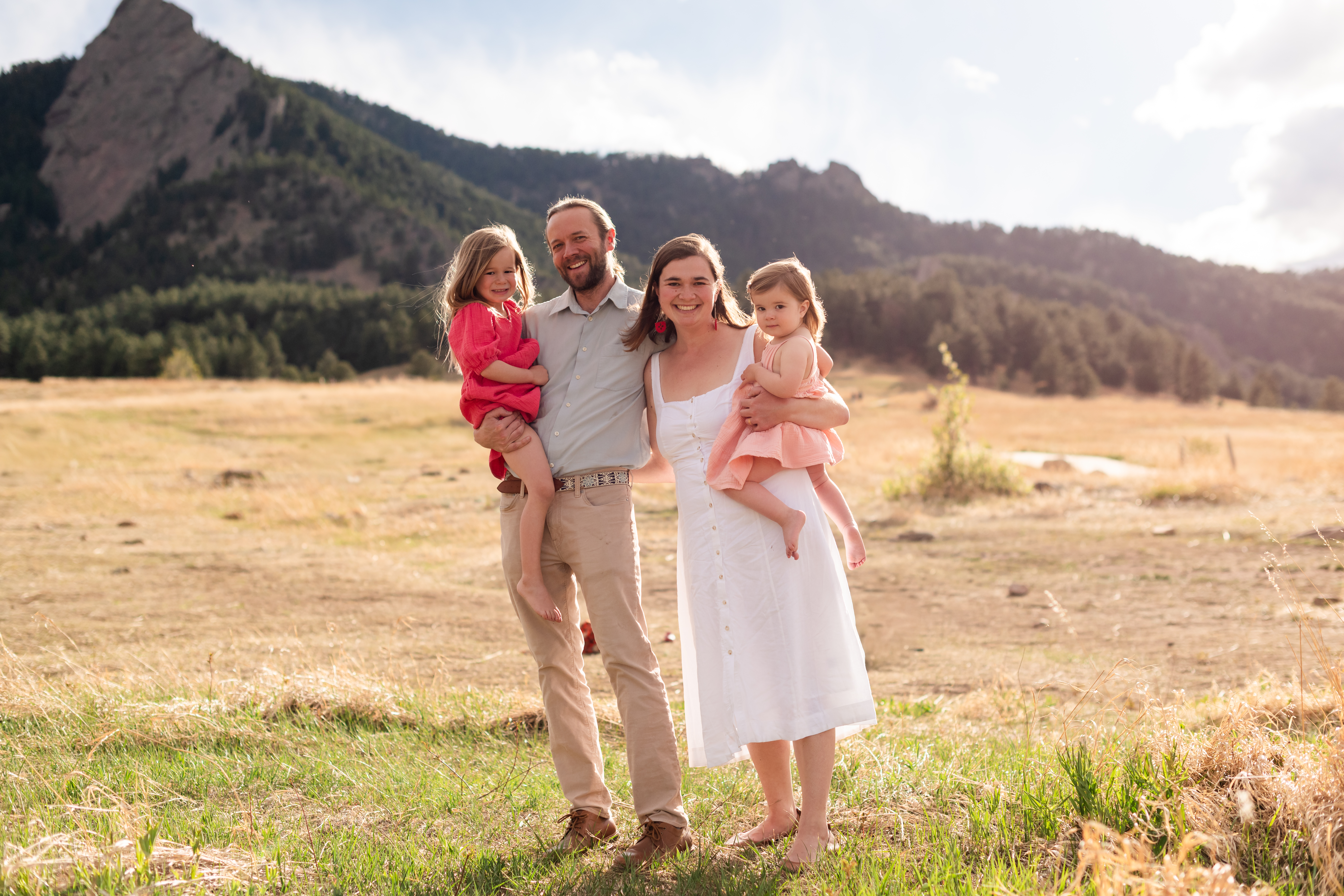
I’m originally from the UK and lived and worked across four countries before settling in Longmont, Colorado, with my wife and two daughters. Away from design work, my interests run toward contemplative, mindful, and meditative practice — something I explore and channel through Everything Vibrations and my own ongoing learning. I also swim, bike, hike, and camp, and I compose music — mostly soundscapes on my acoustic guitar. You can check out and listen to some of it on SoundCloud.