Curriculum Design · Systems Thinking · Integrated Learning · K–5
K–5 Digital Literacy and Computer Science Curriculum
Dean S. Luce Elementary School, Canton Public Schools, MA
Canton Public Schools, MA · 2020–2023
- Curriculum Design
- Systems Thinking
- Integrated Learning
- K–5
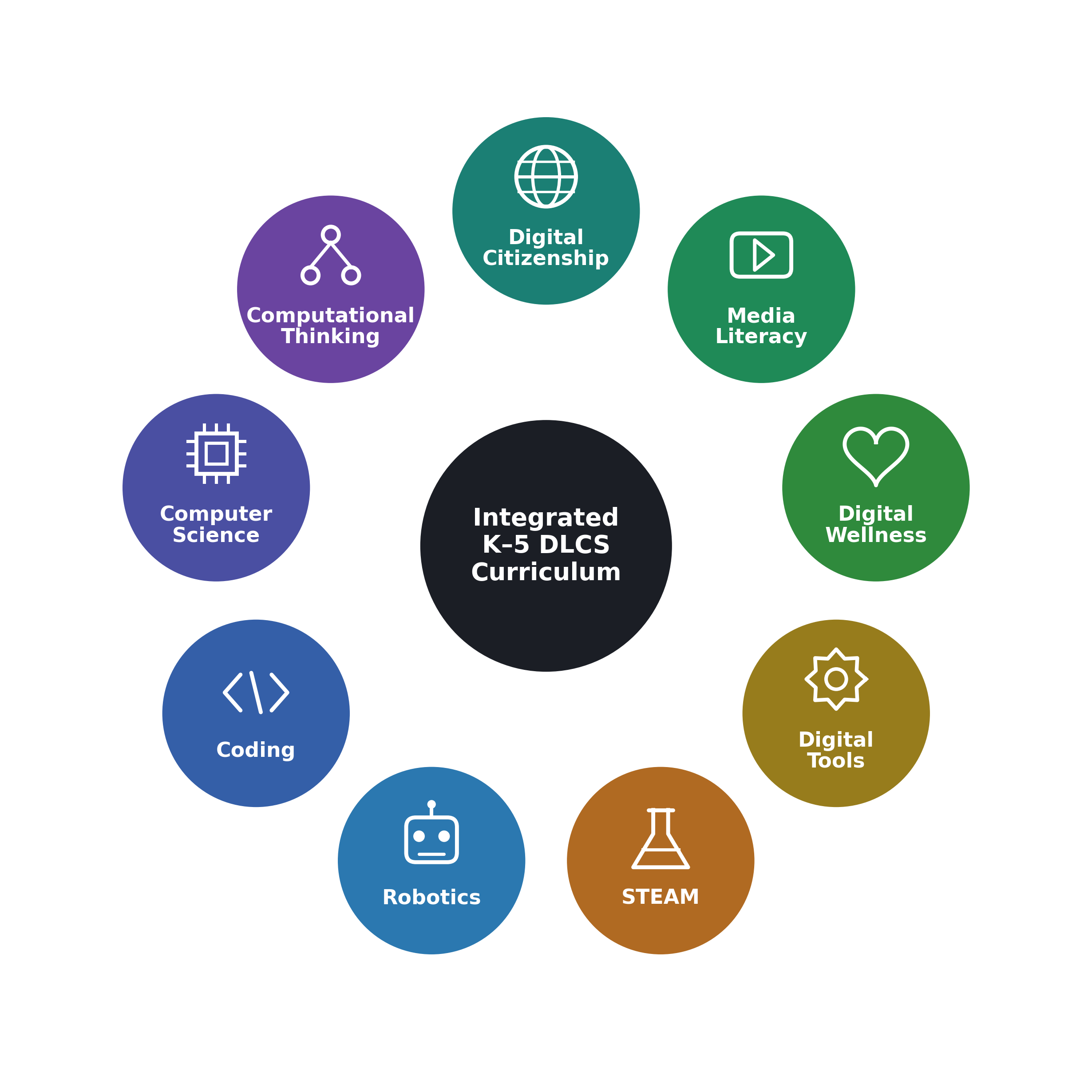
The curriculum spans nine domains — digital citizenship, media literacy, digital wellness, digital tools, STEAM, robotics, coding, computer science, and computational thinking — built across 32 units and six grade levels, K through 5. Each domain is taught in its own right, but deliberately woven into the others wherever it deepens the learning rather than sitting in a separate box.
The full scope and sequence — domains, standards alignment, and representative tools — is available as a one-page overview:
Access the scope and sequence (PDF) (opens in a new tab) ↗
Context
When I joined Luce in October 2020, the COVID-19 pandemic had just redefined what the role was supposed to be. The district had shifted from a traditional technology teacher — a specials class sitting alongside art, music, and PE — to a Digital Learning Specialist, a fundamentally different position: 50% technology education, 50% technology support and facilitation across the whole school. The curriculum expectation had changed, but the curriculum itself hadn’t caught up. The other two district elementary schools were working from something basic, non-comprehensive, and built for a different role. They even needed to start over.
I was new to the role, which meant I was also open to it. Rather than adapting something inadequate, I chose to build from scratch — and I wanted to build something worth having: comprehensive, progressive, and genuinely integrated across its parts rather than treating digital citizenship, computational thinking, media literacy, and computer science as separate boxes to check.
The first two years were hybrid, with some students and teachers still in remote cohorts. The full scheduled weekly lesson cycle — all students, all grade levels, every week — only became possible in year three, when everyone was back in person. That meant the curriculum was being designed and piloted at the same time as the conditions for teaching it were still shifting.
The design problem
The core challenge wasn’t content — it was coherence. Digital literacy and computer science education at the elementary level tends to be fragmented: coding here, digital citizenship there, a media literacy unit somewhere, usually unconnected. Students don’t get to see how these things relate to each other, or to the rest of their learning lives.
I wanted to design something where the connections were built in — where a lesson on STEAM could naturally prompt a conversation about digital citizenship, where media literacy wasn’t a separate unit but a lens students had already been developing since kindergarten, where the same student who learned to cite a source in second grade understood why that mattered when they were evaluating online information in fifth grade. Integration wasn’t a feature of the curriculum. It was the curriculum’s organizing principle.
Architecture
The curriculum spans 32 structured lesson units across six grade levels — K through 5 — all mapped simultaneously, with explicit vertical progression built into every unit. None of the nine domains runs in isolation: digital citizenship is woven into coding lessons, STEAM challenges carry inquiry prompts about responsible use, and media literacy runs through research projects from kindergarten upward.
The tool progression is itself a design decision. K–2 students work on iPads with Seesaw as the learning platform — tactile, visual, low-barrier to entry. Grades 3–5 transition to Chromebooks and the Google Suite, including Google Classroom, Slides, Sites, and Gmail, with Pear Deck layered in for real-time formative assessment and interactive participation. This isn’t just a platform shift — it mirrors the developmental shift from guided exploration to independent creation and collaboration, and it prepares students for the technology environment they’ll encounter in middle school.
The research project is the clearest example of the curriculum’s integrated design philosophy in practice. Spread across three structured lessons — initial research, multimodal creation and collaboration, share and reflect — it was co-planned with the school librarian, deliberately combining physical and digital library resources with online research skills, citation and referencing practice, and digital artifact creation. Each year’s version built progressively on the grade level’s prior skills. It wasn’t a technology lesson or a library lesson. It was both designed together, and neither would have been as strong alone.
Media literacy was the strand I leaned into hardest, because it was the one the available materials covered least. Coding, digital citizenship, and computational thinking had usable resources to build from; media literacy at the elementary level was thin and usually pitched to older students, so I built it up as a K–5 progression in its own right rather than an occasional unit. I deliberately framed it around students as both consumers and creators of media — learning to question what they encounter and to take responsibility for what they make and share. It’s the part of this curriculum that was most genuinely from scratch, and it’s where the standalone media literacy questioning poster in this portfolio came from: a classroom-facing distillation of the inquiry routines the strand was building toward.
What it looked like in practice
The moments I remember most aren’t the lessons that went exactly to plan — they’re the ones where students made connections I hadn’t explicitly taught. Upper elementary students brought up real-world examples in discussions about media credibility or online safety. Younger students applied digital citizenship language in contexts I hadn’t anticipated — noticing something in a video, questioning whether a source was reliable, making the kind of judgment call the curriculum was designed to build toward.
There was also something quieter that mattered: students responding to each other’s work. When students posted digital artifacts to the LMS and their classmates reacted and commented — sometimes seriously, sometimes enthusiastically — it built a sense of community and creative confidence that a solo task couldn’t. The shared space did double duty: having students post and share their projects, and giving them a place to comment, react with emojis, reply, and exchange feedback, created real situations in which I could model and facilitate digital citizenship and media literacy in the moment — how to give constructive feedback, how to respond to others’ work respectfully, how to read and question what they were seeing — rather than teaching those skills only in the abstract. Designing for that sharing and feedback loop was intentional. Learning how to be a thoughtful digital creator and a constructive digital audience are the same skill, and they develop together.
Universal Design for Learning was another consistent thread, in practice rather than in name. Giving students multiple means of action and expression meant that even when a whole class was using the same digital tool, what they produced could be genuinely different — some writing, some drawing, some importing and editing photographs, some using the camera or microphone, and some doing hands-on or hardcopy work and then photographing or filming it to post and share. The task was open enough to allow all of that. The most engaged work I saw across the three years came from lessons where students had real choice in how they showed their thinking.
Collaboration
Most of the collaboration across the school was organic — emerging in response to what a particular teacher, specialist, or grade team needed as the year unfolded. A conversation with a classroom teacher about a unit they were running might lead to an integrated DLCS connection we hadn’t planned. That responsiveness was part of how the role was designed to work.
The librarian partnership was the most structured. Each school year, we co-planned a grade-level media literacy and research unit — formal planning sessions, shared outcomes, and coordinated instruction. It was the curriculum’s clearest example of what cross-specialist collaboration could produce when it was given real time and intention. Students experienced it as one coherent learning experience, not a hand-off between two separate classes.
Reflection
This curriculum was built intuitively and iteratively — designed and taught simultaneously, without the formal design methodology I’d later develop through graduate work and professional training. Looking at it now with that lens, two things stand out most clearly.
The first is design consistency across contexts. The curriculum integrates its themes, but it doesn’t always do so systematically enough. A digital citizenship prompt that appears in a STEAM lesson and a media literacy prompt that appears in a computer science lesson should feel like part of the same visual and cognitive language — familiar inquiry cues, recognizable design patterns that help students know what kind of thinking they’re being asked to do. I was doing this intuitively in places, but not as a deliberate, documented design system. That’s the kind of thing I’d build in from the start now.
The second is student voice. The curriculum shaped what students learned, but students didn’t have structured opportunities to shape the curriculum — to tell me before a unit what they already knew or wanted to know, to reflect during it on what was and wasn’t working, to contribute at the end to how the next year’s version might be different. Participatory design in K–5 doesn’t look like a focus group, but it absolutely looks like something: a simple pre-unit question, a reflection prompt at the end of a lesson, a place where student input is visibly used. I’d build that feedback loop across the full year rather than relying only on my own observation and iteration.
Both of these are things I now know how to design for systematically. Recognizing them here isn’t a criticism of what the curriculum was — it did what it was built to do, and students were better digital learners for it. It’s an honest account of what formal design training adds.
Tools: Google Sites · Seesaw · Google Classroom · Pear Deck · Kodable · Code.org · Scratch · Canva · Beebots · Sphero Indi · Dash · Makey Makey · BrainPOP/Jr. · Common Sense Education · Freckle · Typing Pal
Context: Dean S. Luce Elementary School, Canton Public Schools, MA — Digital Learning Specialist, October 2020–June 2023